
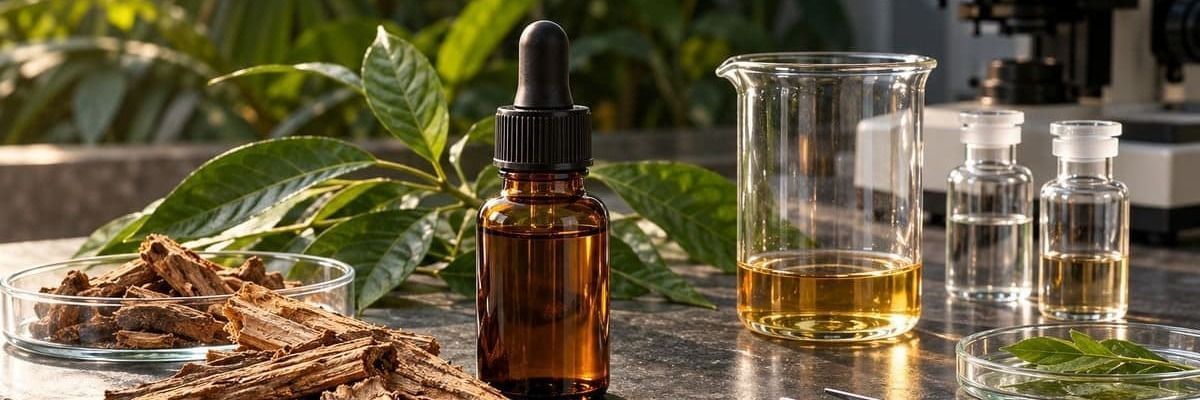
What was studied in the laboratory
The publications found cover two areas: the study of chemical substances in *Tabernaemontana* plants and the testing of the antibacterial activity of the finished preparation.
| Study |
What was investigated |
What the study reveals |
| Van Beek and Verpoorte, 1985 |
Tabernaemontana undulata |
The study is devoted to the phytochemical investigation of the plant. |
| Abilio and co-authors, 2018 | Ready-made Sananga used by indigenous communities in Brazil | Effect of the sample on two types of bacteria under laboratory conditions |
| Chen and co-authors, 2022 |
Twigs and leaves Tabernaemontana sananho |
Which alkaloids were successfully isolated from the plant material under investigation? |
Study of finished drops: Brazil, 2018
Researchers from Universidade Brasil tested Sananga produced and used by indigenous communities in the Alto Juruá region (Envira River). The publication describes the preparation as being derived from *Tabernaemontana sananho*.
The study is titled "Eficácia do colírio Sananga frente às bactérias *Staphylococcus epidermidis* e *Propionibacterium acnes*."
The trial examined the sample's effect on two bacteria:
- *Staphylococcus epidermidis*;
- *Propionibacterium acnes*, also known by its modern name, *Cutibacterium acnes*.
For *S. epidermidis*, the authors reported growth inhibition at a Sananga concentration of 25% in the test mixture and a bactericidal effect at 50%. No antibacterial activity against *P. acnes* was observed under the experimental conditions.
What does this result mean? The tested sample showed activity against one of the two bacteria in a laboratory test. This is a preliminary result that could serve as a basis for further research. Study of the plant's alkaloids: China, 2022
In the paper "Alkaloids from twigs and leaves of *Tabernaemontana sananho*," researchers examined the twigs and leaves of *Tabernaemontana sananho*. The published abstract reports the isolation of 12 alkaloid compounds.
This study helps explore the plant's chemical diversity. However, twigs and leaves are not equivalent to a finished aqueous preparation made from other parts of the plant. Therefore, the results cannot be used as a definitive list of ingredients for any given bottle of Sananga drops.
Even detecting a substance in the plant does not indicate how much of it will end up in the final product. Answering that requires a separate analysis of the drops themselves, as each manufacturer’s formulation may differ.
Study page on the publisher's website.
Bibliographic details: Chen et al., *Chinese Traditional and Herbal Drugs*, 2022; 53(6):1680–1687.
Earlier studies on *Tabernaemontana undulata*
Phytochemical research on plants related to Sananga began long before the advent of modern online stores. In 1985, Van Beek and Verpoorte published "Phytochemical investigation of *Tabernaemontana undulata*" in the journal *Fitoterapia* (56:304–307). This work is cited in subsequent scientific literature.
Record and abstract of the study.
Details of the study (PDF file).
However, the studies found do not provide a universal formula for Sananga.
This article introduces available scientific sources and their research findings; it is not a recommendation and does not replace medical consultation.
You can buy Sananga drops in the Sananga Drops section.


